Jiri Mäntysalo: The EU’s €800 billion military spending plan is unjustifiable and dangerous
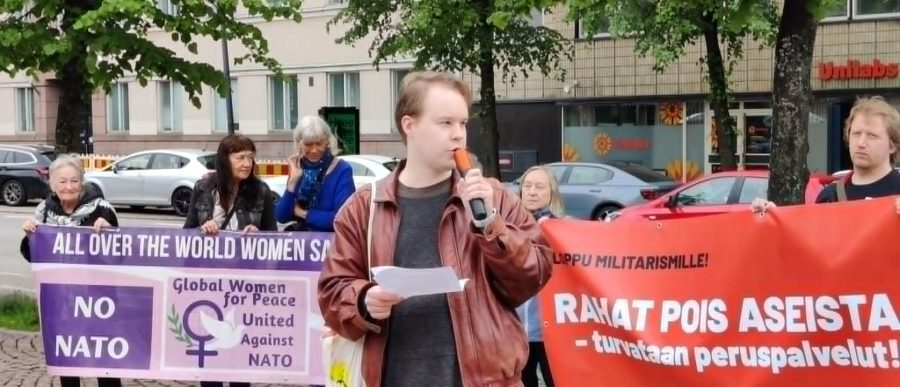
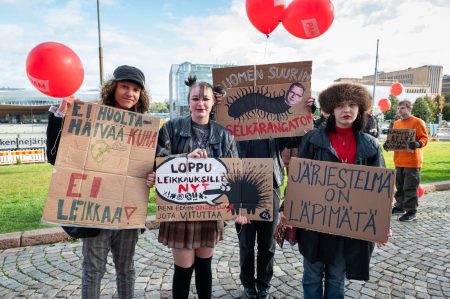
Jiri Mäntysalo, Vice Chairperson of Communist Party of Finland, delivered a speech at the StopReArmEurope demonstration opposing the militarization of Europe in Helsinki on 14 June. On the same day, an international demonstration on the same issue was held in Brussels, attracting 12,000 participants and supported by, among others, Party of the European Left.
Dear friends of peace,
In Europe, the money taps are now wide open. We are not talking about small change, but twelve-digit sums. European countries are joining forces to scrape together urgently needed common funds. 800 billion euros.
Great! Now we can finally invest in social and healthcare services, education, culture, and climate action.
Or maybe not after all. If someone happened to think so, EU Commission President Ursula von der Leyen and the rest of the EU elite are ready to bulldoze those dreams with tanks.
800 billion is not for the people. It is being directed toward arms procurement. The message from von der Leyen and much of the European political elite seems to be that the European poor are not yet poor enough for even more of their livelihood and basic subsistence to be taken away. Working conditions are not yet bad enough that workers’ position could not be further weakened for economic reasons. In their view, the climate crisis can still be postponed, because nature does not even have a voice.
Preventing the threat of war is the best security work. Preparing for war leads to an arms race, which leads to new wars.
The European Union was originally justified as a peace project. But is a peace project one that supports war? One that serves the interests of a single great power and its military alliance, NATO, without an independent foreign policy? One that gives active support to the genocide of Palestinians and Morocco’s illegal occupation of Western Sahara?
The European Union in its current form represents a horrifying world. It is everything that humanity should stand against.
But weapons do not care about humanity. Weapons are made to kill. Their fundamental purpose is maximum destructive power and the spread of death. This is important to remember, because political speeches about defense spending deliberately obscure this fact.
Let us talk for a moment about security. It is a basic right belonging to everyone, which war fundamentally violates. That is why preventing the threat of war is the best security work. No matter what ministers and generals say, preparing for war leads to an arms race, which leads to new wars. If we want peace, we must prepare for peace.
58 percent of Finns oppose the placement of nuclear weapons on Finnish soil.
Security has never been a matter of military deterrence. If security focuses only on borders and the power of violence while neglecting the well-being of the people, then what values and issues are we actually defending?
For us working-class people, security means certainty that help is available when we fall ill. It means education, livelihood, functioning public services, and trust that the future can be better than the present.
I would like to know how these goals can be advanced in a situation where 800 billion euros are being directed toward arms build-up, while in many European countries cuts to everyday security, public services, and social protection have long been ongoing. If money can be found almost without limit for weapons procurement, people have the right to ask why the same opportunities are not seen when it comes to schools, healthcare, housing, or climate action.
800 billion euros says above all something about political priorities and choices. The additional defense funding carved out of national budgets is money that could, if desired, be used for anything else.
The real costs of war and militarism are paid by working-class people. They are seen in high costs of living and in destroyed or neglected infrastructure.
War is not only conflicts between states or other parties. It always involves economic interests as well. When hundreds of billions of euros in arms purchases are being prepared in Europe, shares in the arms industry rise sharply. It is worth noting, however, that the productivity of arms purchases for the national economy is essentially nonexistent.
At the same time, the real costs of war and militarism are paid by working-class people. They are seen in lost lives, in refugeehood, in traumas lasting generations. They are seen in high costs of living and in destroyed or neglected infrastructure. That is why it is dangerous if society begins to treat militarization as a natural or inevitable direction of development.
I oppose the ReArm Europe plan and the thinking it represents. The militarization of Europe increases tensions and escalation and reduces the power of diplomacy. Credible defense is possible with reasonable defense spending. We should promote diplomacy, support cooperation and dialogue, build everyday security, and strengthen safety nets.
We must ask more firmly of Members of Parliament and Members of the European Parliament: Do we want a continent that uses an ever-growing share of its common resources on machines of death? Or a continent known for education, research, welfare, climate responsibility, and peace work?
This question must be answered now.
This is also a question of democracy. For example, according to a recently completed survey, 58 percent of Finns oppose the placement of nuclear weapons on Finnish soil. This must be respected.
Friends, peace is possible to build here and now, when we organize together.
Thank you.
Jiri Mäntysalo
Vice Chairperson
Communist Party of Finland