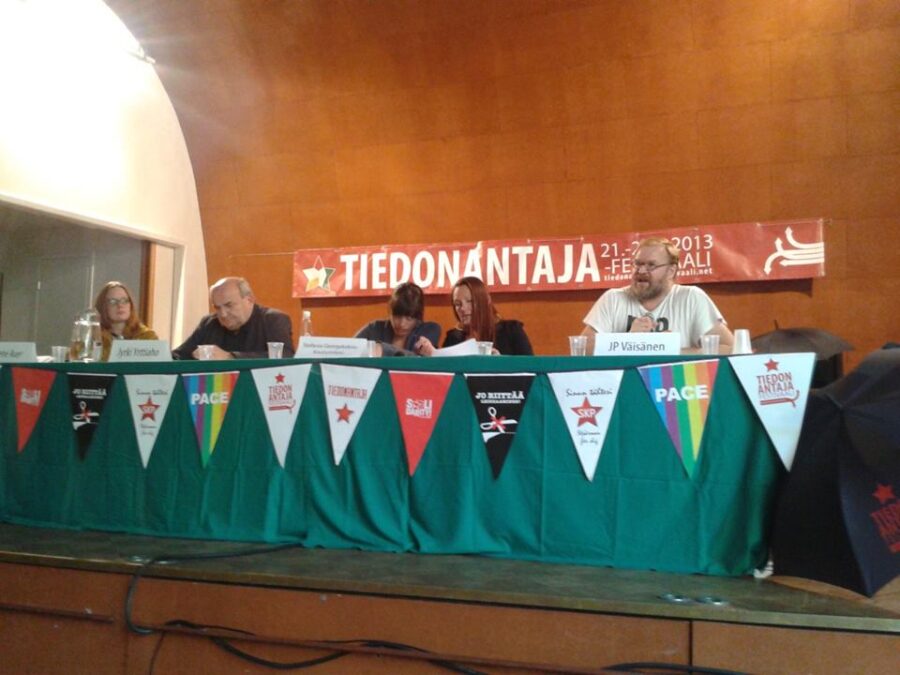
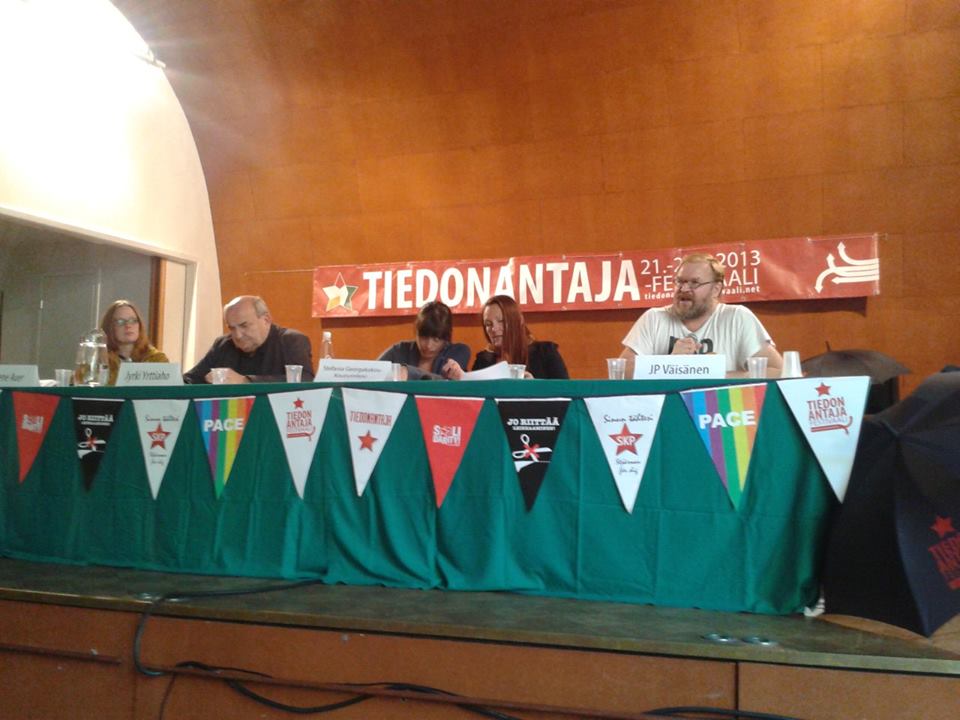
Stefania Georgakakou-Koutsonikou, SYRIZA speech at Tiedonantaja-festival 2013 in Turku, Finland
Dear comrades and friends,
I would like to thank you for your invitation and for the chance to discuss with you about the political situation in Greece, and about the challenges that this situation poses for the Left, not only in Greece but across Europe.
In the past three years Greece has seen a series of memoranda, austerity policies and structural adjustments that have led the Greek economy to a deep recession and the Greek society to unprecedented poverty.
Multiple cuts in wages and pensions, increasing unemployment, rises in tax rates and further withdrawal of state provisions, are some of the most important developments since the first memorandum in May 2010.
Minimum wage has been cut by 22% – 32% for those under 24-, whereas in other European countries minimum wages have generally increased, maybe only frozen for a period of time due to the crisis. Wages above the minimum have also been cut proportionally, as well as all types of pensions.
At the same time, even though slower than before, the price level keeps rising. As a result, purchasing power of the average wage has decreased by 37.2%, dropping to 2003 levels, whereas purchasing power of the lowest wage has dropped to the late 1970’s levels. Internal demand has dropped by 31.3% since 2009, reaching today the levels of 1999.
Exports have increased only a little, but the major proportion (80%) of the current account balance changes is a result of decreasing imports due to falling demand. Imports have decreased by 36% since 2009.
Various tax reforms have taken place, with emergency contributions imposed in many cases irrespective of income status, and a special tax imposed on every house owner.
Unemployment has reached 27%, and 60% in the youth, ages between 15-24. Therefore, migration has increased dramatically, especially among young scientists who seek better working conditions in other European countries, but also USA and Australia, resulting in a large ‘brain-drain’.
The labour market has been drastically restructured by the abolition of sectoral bargaining agreements, the formal introduction of flexible working hours in the new collective agreements, but most importantly the abolition of job security and existing labour regulations in the public sector. 150,000 layoffs and early retirements are scheduled to take place by 2015. The government has already begun by targeting education and the health sector, by closing and merging schools, universities and hospitals and laying off thousands of teachers, health professionals and administrative staff.
At the same time however, no measures have been taken to target actual wealth. Tax rates for businesses have been reduced, employer contributions to social security were reduced by 5%, the tax on large property has not yet been collected, and tax revenues from ship-owners are lower than tax revenues from immigrant green cards.
Despite the large extent of cuts and taxes, the debt is still rising, even though the restructuring that took place in February 2012, wrote off more than 50%, fiscal imbalances still persist, and neither the Greek government, nor European officials deny the need for a new series of austerity measures. At the same time, the government proceeds with a series of privatisations of large extent, in energy, water, public infrastructure, and the social sectors of health and education, claiming that the revenue can be used to refinance the public debt. However, according to even the most favourable predictions the debt will keep rising and everyone now admits that it is no longer viable.
Based on all the above, it would seem that the memoranda and the restructuring programme planned by the Greek governments and the Troika have completely failed regarding the debt-decrease target. One cannot help but wonder, why would the Greek governments and a series of European officials and institutions persist with such a conspicuously false strategy? Could it be that they simply do not see the futility of their policies? Are they simply incapable of implementing an effective economic policy, or plain stupid?
This is the preferred narrative by a series of economists, most belonging to the so-called heterodox tradition, who argue that the failure of the memoranda is due to the inability of those producing and implementing them, a matter of wrong choices regarding economic tools and time-schedules. They argue for a milder and longer adjustment programme that would ease the suffering of the Greek society, and more likely also blunt the increasing dissatisfaction and the social reaction against the government.
I believe that we are in need of a more convincing explanation than that of stupidity. In order to deliver one, we need to resort to the fundamental analytical key of the Marxist tradition: the class struggle. What we argue is that the real aim of the fiscal adjustment programmes was not to target the debt and/or fiscal imbalances, but rather to use the debt as a threat and impose in Greece, as first of a series of countries to follow, structural reforms on labour that will restore capitalist profitability and improve the accumulation process. In that sense, for example, the continuous privatisations are not necessary to finance the debt but rather to provide new areas of capitalist exploitation and accumulation. And it is important to stress that the implementation of these policies are not forced by an outside agent, such as the EU, the ECB or the IMF, in order for foreign national capitals to profit in detriment to others, but rather constitute a strategy that proves profitable first and foremost for the Greek capital.
The basic aim of the policy adopted is the redefinition of the historical limit of needs of the working class, in an attempt to impose a new social paradigm across Europe, for which Greece becomes the experiment. In this paradigm, the needs of the working class are adjusted towards a lower level, presenting previous basic needs (such as housing or welfare provisions) as luxury, abolishing all that the working class had acquired throughout the 20th century.
The success of this plan will depend upon the development of movements of resistance in Greece and across Europe and the success or failure of the working class to oppose it.
Luckily, we are not starting from scratch. The described strategy is under fire and heavily disputed. For the first time after the 70’s, an electoral victory of the radical left and the formation of a truly left government is today not only possible but also probable.
This development has not come out of the blue. It is the result of great social unrest during the past three years and of the strengthening of popular and workers’ movements, in which SYRIZA had a leading role. But it is also the result of a correct political line. SYRIZA was not confined to the role of opposition, but managed to articulate a left and radical alternative and did not hesitate to call for a government of the Left. This choice was not something one would expect from a minor opposition party as SYRIZA was before the 2012 elections. Yet it was a choice that managed to express the popular demand of radical political change. SYRIZA may not have won the elections, but it has managed to open the path to the overthrow of neoliberalism in Greece. The political change in Greece can be the beginning of a crack in the neoliberal hegemony in Europe.
Apart from neoliberalism, the Left is also faced with an additional and dangerous opponent: fascism and the extreme right. The ongoing crisis has given rise to fascist, neonazi, and extreme right movement across Europe, and the problem in Greece has become explosive. The two incidents we had in the past week, coming after a series of others in the past year, the attack on comrades from the Communist Party, with multiple injuries, and the cold blood murder of a young left activist, both taking place in one of the poorest neighbourhoods in Athens, clearly demonstrate the danger we are now facing.
In order to be able to organise strong antifascist movements across Europe, we firstly need to deeply understand what provided the ground for fascism to reappear as a strong political movement. Apart from the economic crisis, and the impoverishment of large parts of the population, it is also the explanations of the crisis that give rise to the extreme right. National narratives and the theoretical conception of Europe divided between the lazy and wasteful South, and the productive and economical North, dominated the political discourse and prepared the ground for the extreme right.
What the Left has to propose is a class analysis of the crisis, and a class oriented solution. We need to make it crystal clear that this is not a war between nations, but a war between classes, and the only political force that can ever express the demands of the working class is the radical Left. It is today our duty, in Greece, in Finland, and all over Europe, to organise the class struggle of the workers of Europe, irrespective of nationality, colour or religion, against the austeritarian neoliberal regimes, and to transform Europe into the Europe of peoples.
Tiedonantaja-festival 2013