Class Struggle on a Pluralist and Feminist Frontline
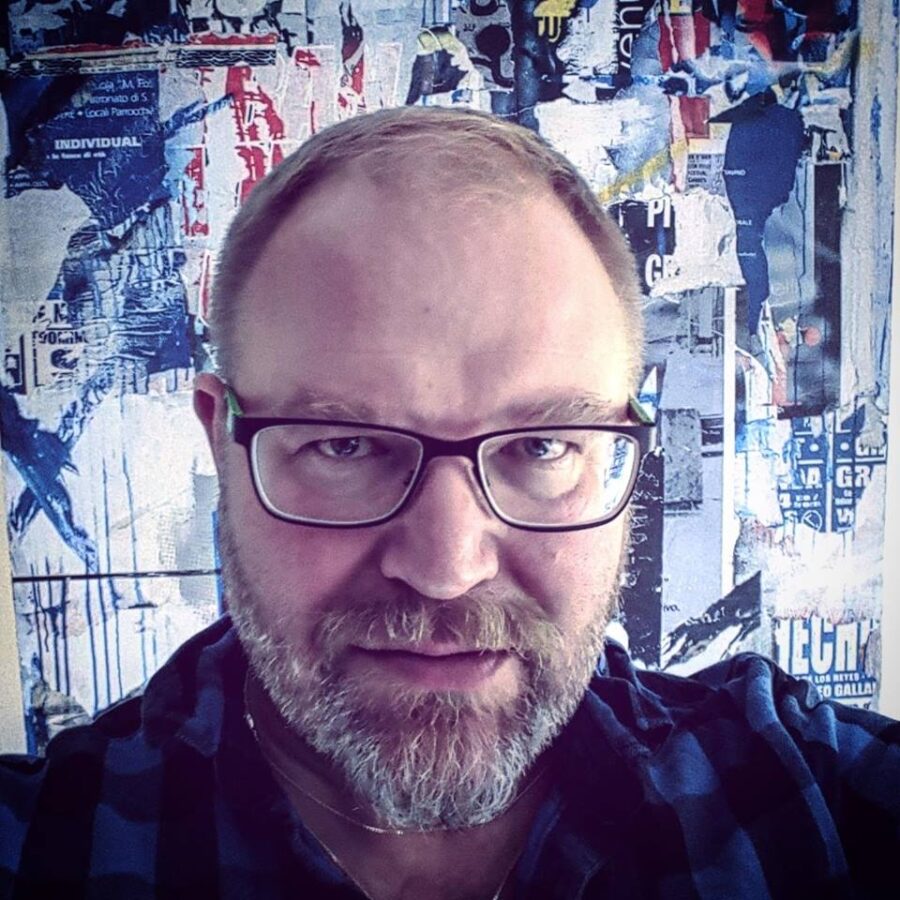
Chairperson JP (Juha-Pekka) Väisänen
CPF Congress 4 June 2016
Political Report of the Central Committee of the Communist Party of Finland to the
To the Party Congress
CLASS STRUGGLE ON A PLURALIST AND FEMINIST FRONTLINE
For the working class, Finnish society is nowadays developing at the beck and call of big money and big business. The political elite and influential parties in Parliament have either bent to the logic of the market economy or have simply given it a blank cheque. What’s worrying from the viewpoint of working women and men is that even the parliamentary Left and the Greens have time and agan been uncritically willing to join government colaitions, even though it means continuing with cuts similar to those we experience now. Not one of the influental parties in Parliament has clearly distanced itself from policies continuing the transfer of incomes from the poor to the rich. This is because the name of the parliamentary game is to get into government at any price whatsoever.
If we put the countries of the world in order of GDP, we see that Finland is ranked somwehere in the top 25, together with Belgium, the UK and Oman. According to a report in Metro newspaper, Norway is the world’s happiest, richest and healthiest country. Finland is ranked ninth among the 10 happiest countries. The indicators used in the rankings use things like GDP and the numbers of people in work. It covers 142 countries. At the bottom we find Afghanistan, Iraq and Yemen.
From the perspective of the working class, prosperity in Finland is distributed unevenly. Globally, the 62 richest people own as much as half the world’s population. According to an Oxfam report, the gulf between rich and poor is fast accelerating.
Last year, some 350 000 asylum seekers crossed borders into Europe. The ratio of asylum seekers coming to Europe to the size of the EU’s 500-million population is 0,07% (January-October 2015). This 0,07% is termed – depending somewhat on who’s talking – a ’wave’ or a ’surge’. It’s actually really only a small ripple.
Wars cause deprivation and anguish, in addition to economic turmoil. According to the UN, the largest numbers of refugees have been from Syria, Iraq and Afghanistan.
In addition to the economic misery, deprivation and fears are caused by wars. In recent years, the United States alone has been fighting and continues to fight in Afghanistan (2001 -), Iraq (2003-2011), Pakistan (2004-), Libya (2011) and then in Syria, Iraq, Libya and Nigeria (2014-). It is specifically because of war that people are forced to flee their homes and seek refuge elsewhere.
COOPERATING WITH OTHERS WANTING CHANGE
The CPF has proposed a policy of cooperation with a wide range of Left and Green forces. Our policy idea is based on cooperation with different forces for change. We cannot and do not want to build a new society by ourselves. A new society will be the result of working together. And clearly this means that we cooperate with different mass movements. In working and acting against the government of Prime Minister Juha Sipilä we have been able to see that cooperation specifically againist the government’s austerity policy has been productive. This cooperation has brought thousands of protestors onto the streets in Finland. The masses of protestors – collective power – have not come onto the streets by dint of Marxist analysis or class-consciousness. Many have come to protest because the hand of right-wing policy has sneaked into their wallets and the lack of basic social security, health services and education is such that they cannot just sit quietly alone at home.
We are in a situation in Finland where right-wing policy has brought young people especially out onto the streets who previously cared little for politics. Finnish youth follow what’s going on in the world. We have had a wave of mass left protest that was born of the progressive initiatve of our French comrades to remain in the Place de la Republique following the protest against the government’s labour law. Instead of returning home they launched a mass gathering that continues to this day.
In Finland, a group of influential figures in cutures and arts and young people in the Collective Power network who have become politicised identified with this nuit debuit – night rebellion movement of French and some other Europeans and have since started once a week to organise a progressive action in the current new way – openly in the centre of the city among all the arts, culture and community facilities.
99 % POWERED
We have a valuable experience of three years back. At that time the small parties in Parliament were in the ’rainbow’ coalition government. Then, too, there was resistance to unequal income distribution and capitalism, not just in Europe but globally. In Finland, there was also action in the name of the Occupy movement that convened activities throughout the winter. We called it the ‘marketplace movement’, and its symbol was a hurricane lamp. In the tents of the markeplace movement folk learnt about and debated various social issues. As communists we had our own place there too. In addition to providing the marketplace movemnet with firewood, we brought to it discussion on class-consciousness and Marxist perspectives. Amidst all the activity of the marketplace movement I remember being amazed at how Left Alliance activists had kept away from the action. The reason for this split was the Left Alliance’s participation in the government coalition. The same reason applies to its avoidance of more conspicuous involvement in the peace movement. From the perspective of citizen action, government work and social responsibility are mutual negatives. Now that both left parties, the Social Democrats and the Left Alliance, are no longer in government they exhibit renewed courage in civic participation; the peace movement has held a united protest against war games, cultural and arts workers have come out against the government’s new definition of artists as entrepreneurs, while pensioners and students have held mass actions against government policy.
The strange feature of many of the demonstrations, however, is that we see some of the key party political figures of government austerity policies being invited to speak. This is an odd Finnish characteristic that we cannot explain other than by the fact that the ruling parties in Parliament want in one way or another to retain their consensus politics identity. It was unbelieveable to hear at the demonstration at Railway Station Sqaure packed with trade unionists government PR spiel about why people’s working hours should be made longer and their pay cut – that is at a demonstration demanding a change of political direction and for fair tripartite talks on pay increases instead of policies pushing down pay levels, an end to intimidation by ‘local’ agreements and an end to the diktat of employers.
SOCIALISM OF THE EARLY 2000s
The developmental problems of Finland and the rest of the world will not be tackled by subjugating politics to the markets, by government austerity policies and people able only to choose differently named parties from the same neo-liberal policy drive.
We need politics where people are not just instruments but are the protagonists and purpose of politics. It is wrong to imagine that we can immediately provide ready-made recipes and plan the stages of change for everything in advance. New left wing radical change desires cooperation and seeks out and realises alternatives together with the people, trade union movement, citizens’ movements and parties that want change.
It is obvious to us that we want to develop common action against neo-liberalism and big capital in order to alter the direction of politics, to expand the rights of working people and the poor, limit the power of monopoly capital, to ensure sustainable development and peace and to open the road to socialism.
The power of capitalist monopolies and financial institutions is from our communist perspective a grave obstacle to rational, just and environmentally sustainable development. Similarly, from the viewpoint of workingmen and workingwomen the greatest threats and uncertainties facing humanity are directly related to the capitalist mode of production and the dominant logic of capital. That is why as communists we say that capitalism is an obstacle to human freedom, the welfare of peoples and a threat to the future of all humanity.
Today we can safely say that, yes, the movements for socialism have experienced disappointments and setbacks, and yet replacing capitalism with a fundamentally different society and form of development is from the perspective of class struggle today all the more crucial. Socialist values persist because any vision of a dignified and positive future without them would be utterly inadequate. The ideals of socialism are palpable and alive in movements that struggle for human rights, equality and freedom.
The ideals and objective of socialism give us as communists a direction in our everyday work and activity. Socialism does not simply denote values and the politics practiced in their name. Revolution means the creation of new power and economic structures, as a result of the struggles of the working class and the majority of the people, that promote the construction of a workers’ Europe, a democratic welfare society, democracy and solidarity, and of a new human civilisation. This is why as communists we say that the revolution is present in our daily work and activities, and more and more so with every passing year.
Socialism signifies profound changes in our relationship with work, power, nature and other people and peoples. Socialism does not mean the abolition of all private ownership, but it does mean various forms of social ownership of the means of production so that the markets can be subjugated to cater for people’s needs and that we can steer development systematically on an environmentally sustainable path. It is a society of highly advanced productive forces.
Crises have always been integral to the history of capitalism and its efforts to solve problems. Now, the crisis is that of the capitalist system, the distinctive feature of which is the devastating effect of massively bloated financial markets. Speculation on the stock market and imaginary expected value suppresses and plunders tha rest of the economy. Another distinctive feature of the system is the concurrence of multiple crises and the refugee crisis triggered by imperialist wars. Capital’s multiple crises combine financial crises, energy, food and environmental crises as well as the crisis of parliamentary democracy. At issue is also the crisis of the current model of economic, social and environmental development.
More than anything, the point is that the major problems facing humanity cannot be solved within the capitalist framework. It is obvious that the financial markets and transnational corporations, the stock markets and the bankers, Shell and McDonald’s have other things in mind than solving the problems of poverty, unemployment, inequality and chilate change. The initiative of socialism in the 2000s is one for a totally different type of society, in which the status of ownership, money and power do not give anyone the scope to exploit and oppress others.
It is precisely as communists that we, together with others who want to bring about change, can meet the prospects of revolutionary change, for socialism in the 2000s. This is a vast challenge for us CPF comrades, who have decided to update the Party programme so that at our next Congress we can decide on the new updated CPF programme.
INTERNTIONAL CLASS POLITICS
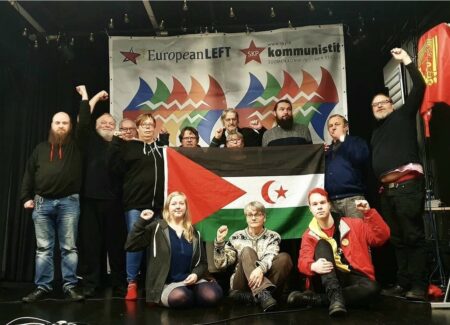
The CPF is a member of the radical family of the European Left. We also naturally have bilateral relations with communist and workers’ partied in the Nordic countries, other parts of Europe and the world. For the CPF it is important to be able to develop international party relations in a more practically oriented, not to say Marxist direction, from a relationship focussing on messages of greetings and conferences and in a direction more closely aligned to campaigning and joint action.
Here, the European Left is an important tool for the CPF. We have been able to develop a variety of campaigns, such as peace initiatives and work on specific issues in the Arctic region; security, the environment, and human rights, both through the European Left and communist and workers’ parties around the world. The Arctic Initiative 6.6. immediately after our Congress shows how with even modest financial resources we can bring together the communist parties of the Arctic region, progressive European parties, NGO representatives researchers, artists and workers to debate and survey the common awareness of Arctic issues that unite us all.
The world’s communist and workers’ parties play an important role in the CPF’s cooperation policy. We have cooperated closely with the Communist Party of Cuba, among others, followed and taken part in the discusson on the process of modernising Cuban socialism. 26 September 2014 was the first International Day on the Total Elimination of Nuclear Weapons. Cuba has been a pioneering state in action to eliminate nuclear weapons. We hope for broad international support for the project and that governments, parliaments and civil societies will observe 26 September each year as international nuclear disarmament day, and in so doing focus attention on the need for the total elimination of nuclear weapons.
Good, comradely relations both with the Embassy here in Finland as with the CPC and with comrades working in Cuba have strengthened the political work of the CPF here in the North.
HATE SPEECH AND POLITICAL PERSPECTIVE
The security policy programme of the Finns Party is that the development of hate crime legislation should not set limits on normal political debate.
I would argue that when ordinary workers blame immigrants for endangering their own basic security, it emanates from rightwing politics and the bourgeois media grinder. This in no way excludes the point that the organisational activities of the working class need to be improved. Collective learning about about social matters and cultural activities are tools for understanding the changing world. Have we organised enough discussions and training courses? Refugees, undocumented people, asylum seekers, the sick, pensioners and the most underprivileged and the scapegoats of neo-liberalism’s politics of greed – not just by accident but completely intentionally.
Though the broad left has not had any electoral successes in the last three years and support for the CPF is miniscule, we have advanced on the wider European front and increased the strength of the Left in the EU Parliament, for instance. The seat won by the Left Alliance’s Merja Kyllönen was an important gain for the Left in Finland. Also, the European trade union movement, particularly the ETUC, has been involved in many labour struggles and general strikes, notably in Central and Southern Europe.
Drawing conclusions on the current situation in Europe and the Euroregion is a key issue for all Communist and Left movements.
For the CPF the situation in Greece is by no means a matter of local curiosity, but rather a question of international class struggle. It cannot be resolved within the borders of a single country, but requires broad international cooperation and a united front. What happens in Greece could well take place elsewhere in Europe, and recur with even worse repurcussions. Europe’s direction cannot be changed unless there is a powerful class struggle Left and working class movement.
It is no doubt that we are in solidarity with the struggle that has taken place in Greece and continues to take place agaonst monopoly capital, the power of money and the power of the banks. The struggle against austerity policies is not a struggle in one country; in Finland or Greece the struggle against austerity policies is at the core of the international class struggle. This is why the various radical Left and Communist struggles against austerity must be supported. We hope that the struggle for another Europe and another world in Finland, Greece and globally becomes stronger through the unity of the working class. The situation in Portugal, where there is a government of social democrats, the Left bloc and the communists, will open up new perspectives and hopes for us on the possibility for Left cooperation.
The age-old struggle of the working class for an egalitarian society must essentially involve a struggle for the self-determination of peoples, equality and human rights. Our demand is for justice, not the racist segregation of workers, longer working hours and Sipilä’s 5% trick about lowering labour costs.
PEACE
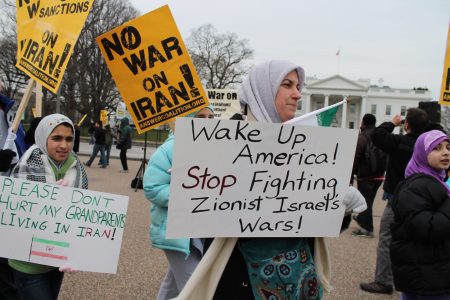
There is no need for foreign fighter jets to be in Finland, nor for foreign tanks nor foreign warships. The annual surveys of support in Finalnd for Nato make it clear that people in Finland are opposed to the military alliance. Previously, the will of the people are been reflected in Finland’s foreign policy emphasis on neutrality. The Sipilä government is now carrying out the policy of the National Coalition Party and is taking Finland towards Nato membership using war games and programmes disguised as cooperation for peace.
Finland’s foreign policy must not be changed towards one of military alliance. This spring, the war games were conducted not with Nato but directly with the United States. Neither MPs nor even ministers have taken responsibility for security policy, and public discussion has mainly been about communication. The US invited itself to Finland, Russia’s neighbor, to conduct war games. Finland and Nato signed the Host Nation Support agreement in autumn 2014. The move towards military alignment is increasing tensions in our region and US – Russian relations have become strained in recent years. Finland is now in danger of becoming caught up in imperialist conflicts.
We must keep Finland out of wars and out of Nato. Finland is not a colony for war games. The Sipilä government’s billion-dollar weapons acquisitions must be reversed and the money used for them used to combat poverty and promote employment. It is absurd to devote millions of euros to US war games in Finland. We call on all peace-loving forces for a return to Finnish non-alignment. We must act as the pioneers of disarmament and for ridding the world of nuclear weapons and other weapons of mass destruction.
The Finnish peace movement’s connection to the rest of the world occasionally rears its head. The problem is that the Finnish peace movement suffers from political timidity, which prevents its internationalisation. The political tensions between the World Peace Council and the Peace Bureau are one reason for the peace movement’s international passivity and caution. The CPF has important bilateral relations on peace issues with many progressive movements in Europe, including in Greece, Portugal, Germany and Denmark. Also, concrete joint initiatives such as the Peace Alert in summer 2015 facilitated dialogue with among others the Chinese peace movement. From the CPF’s peace activist’s perspective it would be desireable if the broad Finnish Left and Green could cooperate better in the future and have political speeches at our events. It is important that peace work can take place at grassroots level as citizen advocacy, but it should also have natural relations with various political forces and it should be able to challenge all influential figures in society to take part in peace building work.
Historically, fascist parties have always been allied with bourgeois elites: big industry, banks, the civil service class and the military. From the perspective of fascist economic history (Hitler, Mussolini) the habitual aim was for war and maintaining powerful armed forces.
The security policy agenda of the Finns party states that Finland will defend Finns and that the keystone of Finnish defence is a territorial defence system based on general conscription. The Finns Party is part of a government that is increasing the defence budget while making sweeping cuts from elsewhere in society, so tat we will soon reach the target of 2% GDP on defence spending of a proper Nato member.
The Finns Party’s security policy agenda views immigration policy as border control and, in addition to police capacity, one of the central factors linked to security. Finland should, according to the agenda, remain outside the planned pan-European immigration and refugee policy, so that Finland could decide for itself how many foreigners we take.
The Finns Party security policy was concretised by the fact that the SSS [Sipilä, Stubbs, Soini – the leaders of the overning coalition parties] government has cut development aid by €300-million. I think that instead of increasing austerity, poverty and injustice we must act differently. The cuts to the development budget must be halted. At a time when the refugees and the Third World crisis are hand in hand our own poverty and deprivation has clearly reached a critical point, it is crucial that economic policy be realigned. Austerity and business policy must be abandoned. People and work to negate poverty must be put first. We must demand that the government increases activity for the world’s most disadvantaged people by making development aid 0,7% of GDP. Similarly, the basic human rights of undocumented people already in Finland, particularly women and children, to such things as health services, must be improved. Finland needs a law on the rights of undocumented people. We need legislation that constrains municipalities to arrange non-emergency health care services, such as pregnancy and maternity care, to undocumented people.
Today it is important that we recall the 2015 Peace Alert done in Helsinki. It will continue to call on people to join actions and campaigns against war games, armed forces, weapons and military bases.
The text of the Peace Alert states clearly that we oppose new war games, new weapoms, new armed forces and new military bases.
RAINBOW POLITICS
Over the last three years tere has been a thoroughgoing discussion in Finland on the status of gender and sexual minorities. The human rights of transgender people are still badly neglected. For us as a party it has been obvious, and in the political bureau we have called for people to be able to notify the registry office themselves of their gender. We have also called for recognition of a third gender, which in practice means that where there is a situation where a physician cannot determine an infant’s gender, they are defined as being of third gender, instead of undergoing gender reassignment surgery.
The CPF has shown itself to be the strongest of the parties when in terms of rainbow politics. It has chosen for its chairperson an openly gay man as its leader and its positions have sought throughout to reach the goals of equality and feminism. Many see the CPF as a pluralist and feminist party. Whether these positions and vision will translate into electoral support is another matter. Firstly, the CPF seeks a membership base of fortitude, class-consciousness and collective power to establish cooperation for a politics in which the struggle for better basic security for all is not a parochial issue but fundamentally international.
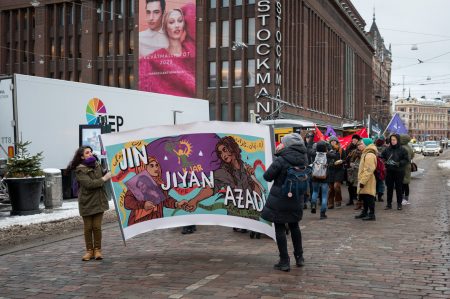
What we need at this time is the fire of passion: we need feminist initiatives from the roots for building a different society. What is needed at this time and in this society are fundamentally different structures that do not pit worker against worker. We need fuel and flame for the kind of society that is based on the age-old trade union demand for equality and justice, peace and participatory democracy. And we need action and the will that unites progressives and subversive forces in a feminist and pluralist popular front against austerity. .
Dear sisters,
In several EU member states economic, immigration, financial and all other crises are cited as reasons for the austerity policies, driving down the public sector and an emphasis on traditional family values that are undermining the situation of women.
The Sipilän government is aligning Finland by this bourgeois policy to the group of countries where governments use austerity as a device for putting women in their place outside of formal working life – if not exactly between the kitchen stove and a hard place, then at least without being paid from within the third sector, where work refers to charity.
Last summer, 85 Finnish professors, university chancellors and heads of research issues a harsh criticism of the government programme of Prime Mininster Sipilä for its complete absence of a gender equality perspective. The crisis policy austerity measures targeting the public sector and services have had a clear gender impact. According to Professor Niklas Bruun of the Hanken School of Economics, the situation of women in particular who are asylumseekers, have disabilities or belong to sexual minorities is worst not only in crisis countries but in the whole EU.
As leftwing European women and femininsts we act and work to oppose patriarchy and the madness of capitalism. The International Women’s Day appeal stressed that in Europe prosperity and wealth must be shared. An open borders policy must be promores, meaning that people fleeing war, poverty and climate change must be helped – asylum must be given, people must be helped.
The statement of women of the European Left /EL-Fem declares, “We women know that all forms of sexual violence take place everywhere in our lives. We women of the Left know that the whole capitalist system is based on violence. Violence is structural, physical and psychological. And this structural violence must be tackled, not just when the offenders are men from other cultures, ibut it must be addressed in every form and structure.”
I agree with this statement. It is important to add to the Finnish debate on rape and violence the Left feminist denouncement or refusal of women being used as a racist policy or discourse tool.
EUROPEAN POLICY
The CPF is is one of the most insightful Left parties in issues of EU relations. In joining the EU, Finnish people were promised peace, freedom and economic growth. These promises now seem grotesque, as the EU elite regulates which policies EU countries are allowed to follow and within the EU we are more concerned about the welfare of investors than with equality, solidarity of the overall state of the national economy.
It is important to examine EU activity and business policy from a working class perspective. EU member states are in an austerity race against democracy and the social Europe. From a feminist perspective we can say that a consequence of the right-wing policy being pursued is disregard for equality and human rights commitments.
For us as communists it is blatantly apparent that in our policies we are not aiming for a parochial national capitalism like the Finns Party or the liberal ultra conservatives, whose hallmark is pretty much along the lines of bringing back the Finnmark and nationalism instead of international ?solidarity.
Fos us as communists it is obvious that talk about bringing back the Finnmark without the demand for overcoming the supremacy of the banks is empty talk. Similarly, talk of leaving the EU is flawed unless at the same time we break with EU treaties and, most importantly, from the hegemonic logic of the market economy and the st