BACKGROUND FOR A CHANGE OF POLICY IN FINLAND AT THE START OF THE CAMPAIGN FOR EU PARLIAMENT ELECTIONS
BACKGROUND FOR A CHANGE OF POLICY IN FINLAND AT THE START OF THE CAMPAIGN FOR EU PARLIAMENT ELECTIONS
by JP (Juha-Pekka) Väisänen
Chairman of the Communist Party of Finland
Helsinki, 5 February 2014
Eight political parties are represented in the Parliament of Finland. Six of them, the National Coalition Party, the Greens, the Swedes, the Christians, the Social Democrats and the Left Alliance form the government. The opposition is made up by the Center Party and the True Finns. According to recent polls, the four major political parties are the Conservative Party, the Center, the True Finns and the Finnish Social Democrats.
Two MPs of the Left Alliance did not approve of the government’s programme and they were expelled from the parliamentary group of the Left Alliance. They established the Left Group. The True Finns expelled one of their MP’s because of his racist activity. He joined the Party called Change 2011, which was not represented in parliament, and founded a parliamentary group named after this Party. The Communist Party of Finland is the largest active political party outside the Parliament. In Finland, only the parties, which are represented in the parliament benefit from public funding. Finland is entitled to 13 seats in the European Parliament. At present, the Christians, the Swedes and the True Finns have one representative each, the Greens and the Social Democrats two representatives and the Coalition Party and the Centre Party have each three representatives in the EU Parliament. The Left Alliance is the only Finnish parliamentary Party without representation in the European Parliament. The Left Alliance is the largest party which is active outside the EU Parliament.
When reporting the daily political news, the media systematically ignores extra parliamentarian political initiatives. All media polls on the future positioning of the parties in the elections to the EU Parliament concentrate exclusively on the parties which are represented in Parliament. For example, with respect to the nomination of candidates, news coverage was limited to the candidates of the parties represented in parliament. The Organization for Security and Cooperation in Europe (OSCE) and the Communist Party of Finland have criticized the media for their one-eyedness. Mainstream media and the Finnish Broadcasting Company reject this criticism and justify their attitude on the basis of the result of previous elections.
The argument of the critical media researcher Naomi Klein with respect to the crisis of democracy, to the one-eyedness of power and media materializes to the letter in Finland.
All parties represented in the Parliament of Finland accept the EU treaties and have adapted to market economy and to the rules of capitalism.
In Finland, only civil society movements, a number of critical trade union activists and, among the political parties, mainly the Communist Party, propose alternatives to the policy of cuts and austerity and to capitalism, as demanded by the political resolution of the recent Congress of the European Left.
Through its acceptance of the coalition government’s agreement Finland’s parliamentary Left has approved EU policy based on cuts in public spending and austerity. In practice, this has meant significant cuts in welfare services and structures. The governmental approach in aiming to adapt the economy to the needs of capitalism and of the market has translated into tax increases and cuts or savings as the government puts it.
The campaign for the EU elections is now taking place in a situation where the parties of the government coalition are weighing to what extent the proposed additional three billion EUR cuts planned for next spring will impact on the voting behavior of the population. It would not do the government any good if the Left Alliance would, having in mind the elections, oppose additional cuts and decide now towards the very end of the legislature to walk out of government. Likewise, it would be problematic for the government if the Greens would leave the government because of a dispute over a contract related to the construction of a nuclear power plant. The EU elections pose the challenge to divert from the initially agreed governmental program aiming to stabilize the economy of the country. In their governmental program, the parties had agreed automatically to budgetary cuts and tax increases. This means that if the State debt trend is not curbed and if the share of the budget deficit will settle over 1 per cent of GDP, the government is, according to the program, empowered to carry out additional cuts.
The government says that its goal is to close the sustainability gap of the economy. Yet, economists express conflicting interpretations of the whole concept of the sustainability gap. Finland has been impoverished and made sick repeating often enough the ”truths” of the Katainen cabinet. Despite the statements of Prime Minister Katainen, the State’s financial assets amount to a total of EUR 62.3 billion, consisting of (31.12.2012) cash and deposits (7.4 billion EUR), shares and other equity (33.4 billion), securities (EUR 1.2 billion), loans receivable (17.0 billion EUR) and other receivables, such as trade credit. In addition, the state has tangible assets: land, forests, buildings, roads, etc. and these are not included in the calculations of the government.
The conclusion of the CPF is that the cuts are not based on economic facts, but they are essentially of political nature and in compliance with the neo-liberal economic policy line generally implemented by right-wing parties. Neither the State deficit or the debt level are unreasonably high. The Communist Party has put forward alternatives to the austerity policy and called for public sector development and decent basic services instead of cuts and increasing unemployment. There is no need to increase the retirement age, no need to reduce pensions as continuously demanded by government. Public consumption and public investment maintain the demand in the economy which, of course, must also be maintained in times of recession. It is wise for the public sector to employ more people when unemployment would otherwise rise. Also, culture and education are much needed tools to overcome difficult times and particularly when recession is at its deepest.
The Communist Party of Finland believes that the decision by the European Left to make the debt issue into a central topic of the EU elections and to collect debt related data from all EL member parties is very necessary. In Finland, the government has committed itself to reduce the Finnish debt ratio and this will have direct impact in terms of destroying the structures of the welfare state. The EL debt seminar can produce significant material for the political battle in a situation such as the one prevailing in Finland.
All the Finnish parties, which at present are represented in the EU parliament, are pro-EU parties. The Left Alliance as a party outside the EU parliament is a pro-EU party too. The True Finns, as a right-wing populist party, or, as they state in a campaign leaflet ”a workers’ party without socialism” attract voices, which are critical of the EU. But the True Finns do not propose to leave the EU or the Euro. The Independence Party and the Change 2011 parliamentary group composed of one MP who broke away from the True Finns, are EU-critical.
The Left Group which is a breakaway group of the Left Alliance develops EU criticism, which is in line with the CPF. The Left Group opposed the adoption of the Lisbon Treaty, the socialization of banks’ risk, the bail outs and funds as well as the austerity policy in the crisis-affected countries. In parliament it has voted against financial austerity, against the cementing of internal devaluation andrestricting of national budgetary authority.
The Left Group, as well as the Communist Party oppose militarization of the EU. It does not accept the road map of the December summit aiming to promote EU and NATO defense planning, common material procurement and interoperability of battle groups capabilities and their use. With the exception of the Left Group, the parliament voted unanimously on the security and defense report. The Left Group opposed the introduction into national legislation of the solidarity and mutual assistance (military) clause contained in the Lisbon Treaty.
The list of candidates of the CPF is based on the concept of progressive cooperation. The Communist Party seeks to collect 20 names of activists who are not necessarily party members and comrades, who represent civil society movements, the trade union movement, activists of the struggle for equality, for human rights, for sexual equality, for environmental protection and for the rights of the working class. The Communist Party of Finland and the Finnish Workers’ Party have agreed on cooperation in the EU elections, as reflected in the presence of 3 FWP’s candidates on the list of the CPF.
One emerging topic during the electoral campaign is the free movement of labour. In this respect, the Communist Party of Finland and the United Left of Estonia decided to cooperate. The statement and the material for the street campaign regarding general and common rights of workers are under preparation in various languages as is the campaign to be launched in the ports, on building sites and in hospitals.
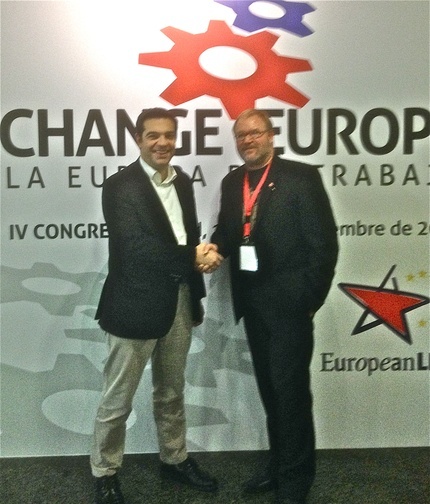
The reasons for CPF candidates to be involved in the European elections are the same as those for which the European Left and Syriza leader Alexis Tsipras run for Presidency: to bring about an honest left-wing alternative to a right-wing policy, which is totally adapted to neoliberal market economy policy, to raise the voice of the discontent and the demand for a different, more democratic and socially just Europe where the human being instead of business is at the heart of policymaking.
CPFinland