Building a Shared Future Through Education, Cooperation and Solidarity
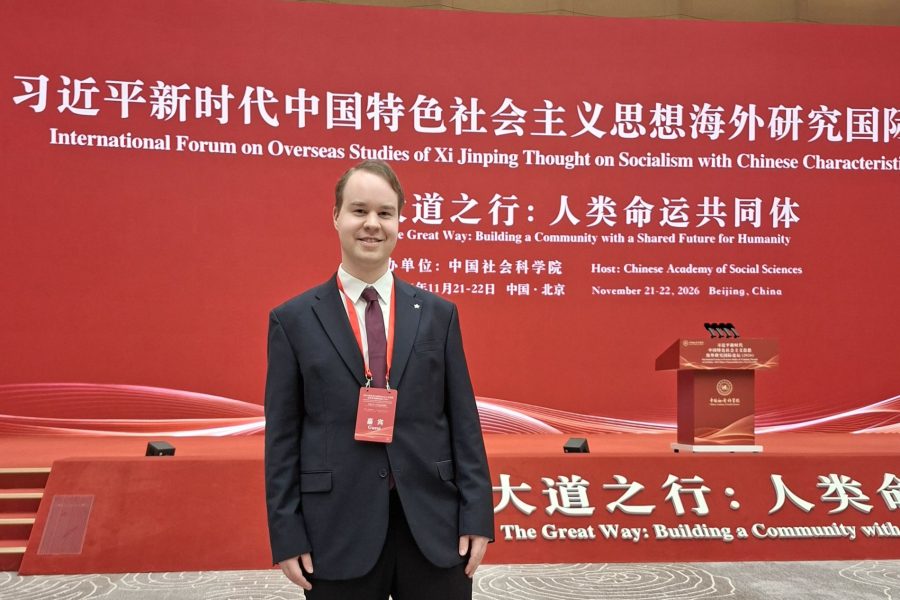
Jiri Mäntysalo, Vice Chairperson of Communist Party of Finland, gave a speech at the OSXJT Forum 2026 (International Forum on Overseas Studies of Xi Jinping’s Thought on Socialism with Chinese Characteristics for a New Era), held in Beijing, China at 21–22 November 2026.
The speech in English:
***
”Distinguished guests, dear colleagues, friends and comrades,
It is a great pleasure to join you here in Beijing and contribute to our discussions on building a community with a shared future for humanity. Thank you to the Chinese Academy of Social Sciences for organizing this important Forum.
I approach this Forum’s subject from the perspective of a Finnish and European Marxist, drawing on my experience in political education, civil society and international solidarity.
Humanity’s ability to produce prosperity has developed enormously, but the systems for distributing its benefits and using resources for the common good have not developed at the same pace. Poverty, inequality, environmental destruction, wars and the arms race continue to affect billions of people.
The success of development should be measured by how it improves people’s lives and gives them opportunities.
This contradiction is deeply connected to the structures of capitalist societies and imperialist world order. Class divisions, short-term economic interests and unequal relations of power shape how resources are produced, distributed and controlled.
The Four Global Initiatives proposed by China provide an important framework for responding global inequalities and building a shared future for humanity. They offer opportunities to address common problems through cooperation, justice and new solutions, focusing on our shared strengths rather than our divisions. China’s achievements in modernization and its experience of Reform and Opening Up also offer valuable lessons for the international community.
In this context, the Communist Party of China’s commitment to staying true to its original aspiration and keeping its mission firmly in mind while building Socialism with Chinese Characteristics offers an important perspective on the relationship between economic development and social progress.
Development, Education and Social Change
The Global Development Initiative promotes people-centered development and international cooperation. These goals are especially relevant in a world where wealth and resources remain deeply unequal.
The success of development should be measured by how it improves people’s lives and gives them opportunities. One of the most effective ways to create opportunities is through education.
In my home country, Finland, trade unions and social movements played a key role in building Finnish society and its public education system, which was once considered among the best in the world.
Investment in education is an investment in the future.
Unfortunately, Finland’s public education system has faced decades of budget cuts and growing inequality. The country’s reputation as a world leader in education is no longer accurate. Declining learning outcomes among young people are particularly worrying.
From a Marxist perspective, we must examine the social and economic conditions behind educational inequality, especially the consequences of neoliberal policies.
Education requires stable public funding and continuous development in cooperation with teachers, other professionals and students. Investment in education is an investment in the future.
Peace and Human Security
The Global Security Initiative emphasizes universal security, peaceful cooperation and dialogue. These principles are urgently needed as military tensions and political conflicts continue to grow, particularly in Europe.
From the perspective of the peace movement, security must be understood broadly, also through the United Nations concept of human security. People need housing, healthcare, education, decent work and a healthy environment. These are the foundations of a safer and dignified everyday life on which security builds.
European Union’s plans to spend additional 800 billion euros on arms are deeply unacceptable.
History shows how militarization and escalating tensions can fuel arms races and increase the danger of war. This makes the European Union’s plans to spend additional 800 billion euros on arms deeply unacceptable.
Lasting peace requires us to address the deeper causes of instability, both between countries and within societies. National sovereignty, self-determination, international law and peaceful dialogue must guide international relations. These principles should apply equally to all countries.
Civilization and Democratic Participation
The Global Civilization Initiative promotes cultural diversity, mutual respect and dialogue between peoples and societies. Its message is particularly important at a time when far right and fascist movements are gaining influence in many parts of the world, dividing people through exclusion and violating their dignity.
One key lesson from the European Left is that the struggle against the far-right must focus on the social conditions that allow it to grow. Right-wing policies sustain and promote alienation, which is the lifeblood of capitalism. Left-wing policies guarantee housing, income security, healthcare, education, jobs and democratic rights. China’s achievements in improving living standards provide important experiences for this discussion.
One key lesson from the European Left is that the struggle against the far-right must focus on the social conditions that allow it to grow.
A decent life and hope for the future are essential foundations of a secure and prosperous society. This matters to everyone, but it has particular significance for young people. The climate crisis, economic insecurity, new technologies and international conflicts are already shaping their future. Young people must have meaningful opportunities to influence the decisions that affect their lives.
The Communist Youth League of China, as the Party’s assistant and reserve force, plays an important role in advancing China’s modernization and building socialism with Chinese characteristics.
Artificial Intelligence and Democratic Control
Technological progress, including artificial intelligence, must be understood through the relationship between productive forces and relations of production. New technology can increase productivity and create wealth, but when private profit remains the main objective, these gains do not necessarily improve people’s lives.
Today, a small number of powerful corporations control much of the infrastructure, data and knowledge behind advanced AI systems. This gives them enormous economic and political influence, while democratic control over these technologies remains limited.
The future of AI depends on who owns it, who controls it and whose interests it serves.
As President, General Secretary Xi Jinping has said, ”AI development should not be a solo performance by a single country, but a symphony of international cooperation.”
Technology should give people more freedom, more time and better lives.
AI could help reduce working hours without reducing wages. It could free teachers and healthcare workers from routine tasks, allowing more time for human interaction. It could also support democratic economic planning and help communities make better decisions.
But these benefits will not appear automatically. They require political choices that place life and the environment above private profits. Technology should give people more freedom, more time and better lives.
Turning Shared Ideas into Action
The Global Governance Initiative brings these themes together by emphasizing a fairer international order, respect for international law, equal rights for all nations and stronger international cooperation.
Political leadership requires responsibility and public trust. In this context, the Communist Party of China’s work to prevent corruption through discipline, institutions and political education deserves attention. Its principle that officials should not dare to, be able to, or want to engage in corruption reflects the importance of addressing corruption at several levels.
Dear colleagues, friends and comrades,
Education gives people the knowledge and skills to participate. Participation builds cooperation, collective strength and solidarity that makes social change possible.
China’s Four Global Initiatives offer a framework for moving this work forward. Building a shared future of peace and equality is our common responsibility.
Thank you.”